
Lincoln Cents on Dime Planchets
by Jon Sullivan
One of the most popular error types is the off-metal Lincoln cent struck on a dime planchet. These odd looking, silver or clad cents are visually striking, and even someone who doesn’t collect errors will easily see that something is not right about the coin!
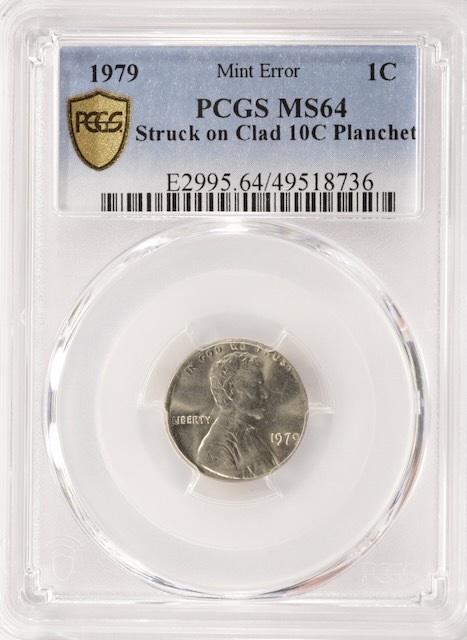
Above: 1979 Lincoln Cent Struck on a Clad Dime Planchet
An off-metal Lincoln cents struck on dime planchet occur when a planchet intended for striking into a dime, instead is fed into a press that is striking Lincoln cents and is struck with the cent dies. The result is a coin with the planchet of a dime, but the design of a cent! Because the cent is struck on a metal that is the incorrect type for a cent (it will be on a clad or silver planchet, depending on the date) the coin is considered to be an off-metal.
So how does a dime planchet end up in a press that is striking Lincoln cents? This is likely the result of the sharing of planchet bins. These large bins (similar to a large square trash can) are used to transport the planchets to the presses for striking, and if a planchet bin was used for two different denominations of coins, such as first for dimes and second for cents, and if it was not emptied out properly, leftover dime planchets could remain in the bottom of the bin. When a new denomination of coin planchets, such as cent planchets, are placed in the bin for transport, those remaining planchets at the bottom of the bin could be fed into the press for the incorrect denomination of coin—in this case, dime planchets into a cent press, and the result would be a cent struck on a dime planchet.
How are cents on dime planchets collected? Perhaps the most popular way is simply to buy an example for you collection that is meaningful to the collector. Examples of this would include a rare date that is (for that reason) more exciting to own. Another popular way is to buy one that is from he birth year of the collector. Other collectors will just buy one with great eye-appeal, or simply that is within their budget.
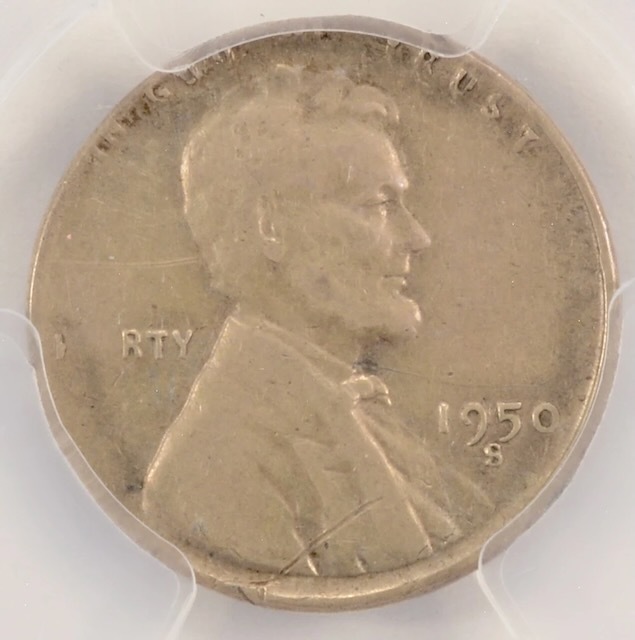
Above: A Scarce Date 1950-S Cent on Dime Planchet
A much more challenging way is to collect the by date. This would mean the collector would attempt to get every date of cent. Most of the time, collects will go for either the wheat cent years of 1909-1958, which will be “silver cents”, or they will go for the Memorial years 1959-2008. The years after 2008 are nearly impossible to find due to their rarity, so acquiring even a single example after 2008 would be very difficult and an achievement in itself!
Counterfeits are known on silver cents, although they are not common. Be particularly of the more recent design, shield cents, as their are counterfeits are commonly found, although most all of them are overstruck on struck dimes (double-denominations.) Other things to be aware of are “test cuts” on off-metals. Although mostly accepted, particularly for rare dates, they are still something that should be accounted for in the grade and desirability of the coin. These takes the form of tiny notches of metal cut out of the coin’s edge, or as a small scratch somewhere on the coin. When in doubt, ask an expert for their opinion about your coin. Unless you are yourself an expert, it is recommended to buy certified with a reputable 3rd party grading service,
For modern (1965-present) cents on dimes, grades of MS63 or higher is the norm, and lower grade pieces are actually less common than mint state pieces. Most cents on dimes did not circulate, and were quickly pulled from circulation. An AU set would in fact be harder to complete, if not impossible, than a mintstate set!
Silver cents are another matter, particularly in the wheat cents and earlier, which frequently did circulate for a time, and some well worn pieces, with grades of VF or lower are not uncommon. However, they also tended to be pulled out of circulation early, and usually grade XF or higher grade. Often times the silver wheat cents will come damaged (scratched, etc), which grading services will frequently compute into the coins grade because they are so common on them. The scratches were at that time likely done to see if the coin was counterfeit or plated.
Collecting cents on dime planchets is easy if you are looking for a few examples for your set, and the coins will make a nice accompaniment to a non-error collect of Lincoln cents, or simply as example of the error type in your error collection. A really challenging set made up of a small run of a few rare dates or very high grade examples, and perhaps a few proof cent on a dimes would make for an interesting collection, or an attempt for a date set would be a fun and rewarding way to build a set as well.